Admiral Sir
HUGH PALLISER, Bt 1723-1796
Admiral of
the Blue
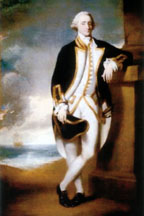
Source - Charnock,
J. Biographia navalis… from … 1660 to the present
time. 6v. 1794-98.
PALLISER, Sir Hugh, Bart. -
This brave man, and judicious officer, was descended from an ancient and
respectable family possessed of a considerable estate at Newby-wisk, in
Sir Hugh Palliser was born
at Kirk Deighton, in the
He also received honourable marks of approbation from his sovereign, though
experiencing what officers of the most eminent merit had encountered before
him, the jealousy and ill-will of the envious, which attach to the nature of
all popular governments like that of Britain. These in the end instigated the
attack of a powerful party upon sir Hugh, who declared himself equally zealous
for the public service under all administrations, without courting or
professing to be of any party.
He was made lieutenant in
1742; in that station he became first of the Essex, commanded by captain
Richard Norris, in the engagement off Toulon, on the 11th of
February, 1744. Captain Norris being backward and behaving ill, was ordered to
be tried by a court-martial; but the court construing the order to be only for
a court of enquiry, the captain was permitted to quit at
In July 1746 lieutenant
Palliser was promoted to be commander of the Weazle
sloop; and, on his station off Beachy Head in a very short time he captured
four French privateers which acquired him, on the 25th of November
following, the rank of post captain in the Captain, of seventy guns, under
commodore Legge, just appointed commander-in-chief at
the Leeward Islands, on whose death captain Palliser moved into the Sutherland,
of fifty guns, that he might accommodate the senior captain (afterwards sir
George Pococke) with the large ship. The Sutherland
having been dismasted in an hurricane, captain Palliser lost the opportunity of
sharing with the rest of the fleet in the capture of a very large French
convoy, which had been dispersed by sir Edward Hawke.
An additional misfortune
afterwards befell him in the same ship when cruising to the leeward of Martinico: being in want of water he proceeded to
Notwithstanding this
accident he persevered in following the service, being in commission for the
Sheerness frigate, on the peace with
In the beginning of the year
1753 he was appointed captain of the
Hostilities having commenced
with
In July 1758, captain
Palliser being then commanded of the Shrewsbury, of seventy-four guns, to which
ship he had been appointed in the early part of the year, lord Anson detached
him with a squadron to cruize as near the entrance of
Brest as he could with safety, in order to watch the French fleet in the road.
Whilst on that service he fell in with a fleet of coasters, under convoy of two
frigates, which he drove on shore at the entrance of the bay D'Hodiernes, and captured some of the trading vessels.
In the year 1759 he was,
with admiral Saunders, on the successful expedition against
In 1762 he was dispatched
with three ships of the line and a frigate to retake St. John's in
Newfoundland; but on his arrival he found that lord
Colville and colonel Amherst had anticipated that service: and, after the peace
in 1764, he was sent out thither again as governor and commodore for the
protection of that Fishery, against the encroachments of the French, having
under him a fifty-gun ship, the Guernsey, which bore his broad pendant, and
several frigates. He then met with a French commodore with a similar force
pretending to regulate their own fisheries and settle disputes with ours, but,
in reality, increasing them; wherefore commodore Palliser warned the French
commodore to quite the coast, informing him that the sovereignty of the island
belonged to Great Britain, and that he would not suffer any foreign authority
to interfere with his government. On account of this and other spirited
exertions, the French ambassador, in
In 1770 commodore Palliser
was appointed comptroller of the navy, and elected an elder brother of the
Trinity House. In 1773 he was created a baronet; in 1774 chosen representative
in parliament for Scarborough; in 1775 promoted to be a flag-officer; and, as
at that time it was a rule that a comptroller of the navy should not hold his
seat at the board with his flag, he was appointed on of the lords of the
admiralty, as successor to the earl of Bristol. In the same year his great
friend, sir Charles Saunders, died, leaving him a legacy of 5000L and sir Hugh
Palliser succeeded him as lieutenant-general of marines. On
Towards the end of 1777, and
in the beginning of 1778, the warlike preparations made by the French
manifested their intentions to support the revolted English colonies against
the mother country. The American war at this time was very unpopular, and all
possible means were made use of, according to a well-known phrase, both within
and without doors, to retard the operations of government. There were
notwithstanding many well-intentioned persons of rank in the opposition, who,
though they disapproved the American war, could not silently behold the
armaments of a natural enemy going forward; they therefore gave early
intimation of the danger: of this number was admiral Keppel, who at that time
resided on the Continent, and was in the habit of corresponding with sir Hugh
Palliser. When the opposing fleet of England was preparing, the latter laboured much, and at length succeeded in bringing about
the appointment of the former to the chief command, being himself selected to
serve under him in the third station: with this admiral Keppel expressed
himself well pleased, and informed sir Hugh, by letter, that he was one of the
very few he could depend on. The indecisive action which took place with the
enemy on the 27th of July following, is not only too well known to
be now described, but has been already sufficiently enlarged on in our account
of the commander-in-chief. The subsequent disagreement between those officers
seemed converted into mischievous consequences, as we have already very forcibly
remarked, by the rancour of party and the wickedness
of interested persons. Doubtless both the admirals were unitedly zealous in
doing their duty to the utmost against the insidious designs of France, the
ambitious and hereditary enemy of their country; but as the event of the 27th
of July, was unsatisfactory to the nation in general, the opposition took
advantage of the discontents to inflame the country against the ministry, first
by suggesting that admiral Keppel had orders not to act with vigour against the enemy; and, when the falsity of that
assertion was exposed, by attributing, as a second charge, the ill success of
the fleet to the difference between admiral Keppel and sir Hugh Palliser, in
political principles on the American war, they coloured
the aspersion by referring to the situation of the latter as an active lord of
the admiralty; they of course represented him as the supporter of the existing
administration, and by implication subservient to certain pretended views of
debasing their friend the commander-in-chief. Thus the whole weight of popular
opposition was employed to transfer the cause of disappointment to the junior
officer: this was done while both parties were again absent at sea, and
apparently on the same confidential and friendly footing as before.
The fleet returned to
Spithead on the 26th of October, and sir Hugh Palliser finding that
many envious insinuations and gross falsehoods had made strong impressions to
his prejudice, he traced and discovered them, as he supposed, industriously
circulated from dangerous quarters, on which he demanded, but could not obtain
what he demanded, a fair discussion. Sir Hugh then took such decisive steps as
brought on him the disagreeable but absolute necessity of calling for
courts-martial on admiral Keppel and himself, that each might have an
opportunity of vindicating his own conduct, and the nation be satisfied where
the blame lay. The trials accordingly commenced; that of Mr. Keppel ended in
the manner well-remembered and already stated: and, in conclusion, sir Hugh
Palliser was acquitted, and the sentence declared, that his behaviour,
on the 27th and 28th of July, was highly meritorious
and exemplary, than which nothing could be more honourable.
During these commotions, sir
Hugh Palliser having resigned the lieutenant-generalship of marines, and his
seat in parliament, to accommodate a timid ministry who stood in awe of a
powerful opposition, his majesty, on his honourable
acquittal, was graciously pleased soon afterwards to appoint him governor of
Greenwich-hospital, on the death of sir Charles Hardy. He was again chosen
representative in parliament for the borough of Huntingdon; but at the ensuing
general election, his old connexions and friends
having coalesced with the opposition, his and their own enemies, he declined
appearing any longer in so public a character, and retreated to the comforts of
retirement with the most valuable blessings that heaven can bestow in this
life, contentment, peace, and purity of mind.
He died admiral of the
white, governor of Scarborough-castle, one of the elder brethren of the
trinity-house, and governor of Greenwich-hospital, at his country seat, the Vache, in Buckinghamshire, on
the 19th of March, 1796, aged seventy-four,
in consequence of a disorder induced by the wounds received on board the
Sutherland, in 1747, as mentioned in the former part of this narrative. The
title descends to his great nephew, Hugh Palliser Walters, esq.
And he left considerable sums for charitable purposes, with many legacies; but
the bulk of his fortune, real and personal, he willed to his natural son,
George Palliser, esq. A suitable monument is erected
to his memory in the parish

An anonymous writer, who
certainly was no relative or interested person, from his having much mistated the manner in which he
received his fatal hurt, gives the following character of him.
"As a professional man,
he was found superior to most of his contemporaries [sic] in maritime skill,
judicious in his dispositions and decisive in their consequent operations; in
private life, conciliating in his manners and unshaken in his friendships; the
wife and salutary laws which he caused to be enacted for the benefit of his
country, and the comfort and happiness of the poor fishermen in Newfoundland,
during his government of that island, are proofs of a sound mind, of a humane
and benevolent disposition."
To this character we have
briefly to add from ourselves, that however his friends may wish he had in some
few points acted differently from what he did, his most violent enemies cannot
but confess their own malignity, in having endeavoured to attach, as crimes to
him, things which never existed even in his thought, and in having reprobated
those very errors which their own conduct fatally gave birth to.
It is no difficult matter to
draw a conclusion from facts after they have taken place; and we believe no
moderate man will, at the present day, deny, that if the popular voice had been
less clamorous, neither party would have proceeded to the lengths they did; the
service would not have been rent into contending factions and parties, and the
public cause of the country would have been materially benefited. No one can
dispute on the one hand that the vice-admiral possessed a warm temper, and in
too great a degree for a cautious or designing man; so on the other can no one
disbelieve him to have possessed honour, judgement, and intrepidity.
For more than the last
fifteen or sixteen years of his life he seldom or ever lay down on a bed from
the constant pain in his leg, which he bore with the most manly fortitude. He
was under the necessity of composing himself in an easy chair, sleeping at
intervals; and when awake he placed the wounded limb on the contrary knee, in
which position he employed himself in rubbing the bone (for it was literally no
more) to assuage the pain till sleep again insensibly overtook him.
[Footnotes omitted from
original extract- TJS]
Note by TJS: Admiral Sir
Hugh Palliser was cousin to William Palliser, Archbishop of Cashel.
The
ancestry of Admiral Sir Hugh Palliser
Other websites:
Captain
Cook Memorial raised by Admiral Sir Hugh Palliser
Palliser's Act,
Newfoundland, 1775
Designed and created by TJ Simmonds

Return to Well-Known Pallisers
© COPYRIGHT TJ SIMMONDS 1997-2017.